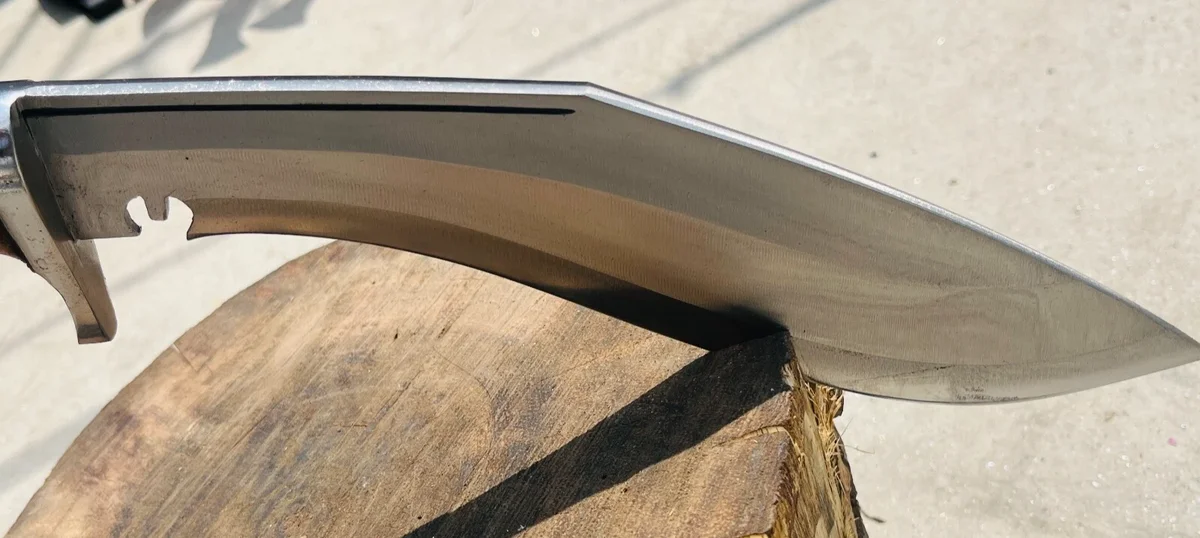
What comes to mind when you think of Nepal?
The Himalayas.
Mount Everest.
Prayer flags.
Temples.
Gurkha soldiers.
And for many people around the world, there is another unmistakable symbol:
The Khukuri.
With its distinctive curved blade, traditional handle and handcrafted character, the Nepali Khukuri is instantly recognizable.
But a Khukuri is not important to Nepal simply because it is a famous knife.
It represents something deeper — craftsmanship, tradition, practical life, cultural identity and a connection between Nepal and the rest of the world.
That is what makes the Khukuri worth understanding.
And that is why a handmade Khukuri can be much more meaningful than an ordinary knife.
What Makes the Khukuri Special?
The first thing people notice is the shape.
The curved blade gives the Khukuri an appearance unlike most conventional knives. But the shape is not simply decorative. The Khukuri developed as a practical cutting tool and also became strongly associated with military use.
Historical accounts of Gurkha soldiers describe the Khukuri as useful not only in warfare but also for ordinary work where a knife or small hatchet was needed.
That combination of practicality and tradition is an important part of its identity.
It is a knife with a purpose, but it also became a symbol.
The Khukuri in Nepali Culture
Nepal is known for its rich traditions of handmade art and craftsmanship.
Across the Kathmandu Valley and other parts of Nepal, generations of artisans have preserved skills in metalwork, woodcarving, sculpture, pottery and other traditional crafts. The Nepal Tourism Board specifically identifies the Khukuri as a famous knife made by Nepalese craftsmen.
This is important when understanding the cultural value of the Khukuri.
A traditional Khukuri is not simply something manufactured to look Nepalese.
Its identity is connected to the people who shape it.
The steel, handle, scabbard and finishing come together to create an object that reflects a tradition of practical craftsmanship.
That is why the Khukuri belongs naturally among Nepal's handmade cultural products.
How the Khukuri Connects Nepali Culture with the World
The story of the Khukuri did not stay within Nepal.
Through Gurkha service, tourism, migration, craftsmanship and international collecting, the Khukuri became recognized far beyond the Himalayas.
Today, its curved blade is one of the objects most strongly associated internationally with Nepal and the Gurkha tradition. The National Army Museum describes the Khukuri as an iconic weapon associated with the Gurkhas of Nepal.
For visitors to Nepal, a Khukuri can become more than a souvenir.
It can become a physical reminder of the country they experienced — its mountains, cities, people and craftsmanship.
The Nepal Tourism Board itself lists Khukuri among the handmade products visitors can take home from Nepal.
For international collectors, the attraction can be different.
They may appreciate the unusual blade design, the handmade construction, the connection to Gurkha heritage or the opportunity to own an authentic product associated with Nepal.
This creates a cultural exchange:
Nepal shares its craftsmanship with the world, and the world keeps discovering Nepal through its craftsmanship.
That is one reason the Khukuri remains relevant today.
Why the Khukuri Still Has a Place in Modern Life
The Khukuri has changed with the times, but its identity has remained strong.
Today, people may purchase or collect Khukuris for different reasons, including:
- Traditional Nepalese collections
- Cultural and heritage displays
- Handmade knife collections
- Outdoor and camping interests
- Appropriate chopping and utility work
- Gurkha and Nepal heritage collections
- Unique handmade gifts
- Interest in traditional craftsmanship
The purpose depends on the design and the owner.
What remains consistent is the connection to Nepalese craftsmanship.
A modern customer may live thousands of kilometres from Kathmandu, yet still own an object made by a Nepalese craftsman.
That is the remarkable journey of the Khukuri.
Why Buy a Khukuri from Kathmandu Forge?
When buying a handmade Khukuri, the question should not only be:
"What does it look like?"
It should also be:
Where was it made?
Who made it?
What materials were used?
What tradition does it represent?
At Kathmandu Forge, our answer is simple:
Kathmandu, Nepal.
We focus on bringing Nepalese Khukuri craftsmanship to customers who appreciate traditional handmade products.
Our goal is to give customers more than a product photograph and a list of specifications.
We want you to understand the story, craftsmanship and cultural background behind the Khukuri you are considering.
From the blade to the handle and scabbard, the details matter.
And because our products are handmade, individual pieces can have natural variations in wood grain, finish and dimensions.
Those variations are part of the handmade character.
Bringing Nepal to Customers Around the World
This is where Kathmandu Forge becomes part of the modern Khukuri story.
A craftsman can work in Kathmandu, Nepal, while the person who eventually owns that Khukuri may live in the United States, Canada, the United Kingdom, Europe, Australia or somewhere else entirely.
The physical distance may be enormous.
But the cultural connection remains.
Made in Nepal.
Appreciated around the world.
Someone can discover Nepalese craftsmanship without having visited Nepal.
Someone who has travelled through Nepal can keep a physical reminder of the country.
And a collector can learn about Nepal through an object made by its craftsmen.
For Kathmandu Forge, this connection is at the heart of what we do.
We are not simply sending a knife from one country to another.
We are helping a traditional Nepalese craft reach people who appreciate its story.
More Than a Product
A successful handmade product is not only about selling an object.
It is about preserving the reason people want that object in the first place.
The Khukuri carries several layers of meaning:
It is a traditional Nepalese blade.
It represents craftsmanship.
It has a connection with Gurkha heritage.
It has practical roots.
It is recognized internationally as a symbol associated with Nepal.
And today, it provides a way for people outside Nepal to connect with Nepalese culture through a physical object.
That is why we believe a Khukuri should be introduced not simply as a knife.
It should be understood as a piece of Nepalese craftsmanship shaped by human hands and carried into the modern world.
A Khukuri as a Connection to Nepal
Imagine buying a handmade Khukuri after visiting Nepal.
Years later, you see it again.
You remember Kathmandu.
You remember the streets.
The mountains.
The temples.
The people.
The sound of the city.
The experience.
The object becomes connected to the memory.
For someone who has never visited Nepal, the experience can work differently.
The Khukuri can become a starting point for discovering Nepalese culture, craftsmanship and history.
That is the beauty of cultural objects.
They can travel.
And when they travel, their stories travel with them.
Choosing a Handmade Khukuri
If you are considering purchasing a Nepalese Khukuri, look beyond the photograph.
Origin
Where was the Khukuri made?
If authentic Nepalese craftsmanship is important to you, look for clear information about its origin.
Craftsmanship
Look at the blade, handle, fittings and scabbard.
The small details often tell you more than a product title.
Materials
Look for clear information about the steel, handle material and scabbard.
Purpose
Think about why you want the Khukuri.
Is it for a collection?
A cultural display?
A traditional knife collection?
Outdoor or utility use where appropriate?
Or simply because you appreciate Nepalese craftsmanship?
Knowing your purpose helps you choose the right style.
From Kathmandu to the World
The Khukuri's journey is fascinating.
It began as part of Nepalese life and became associated with military and Gurkha traditions.
It became a recognizable symbol of Nepal.
It became a popular cultural product for visitors.
And today, it continues to travel from Nepal to homes and collections around the world.
At Kathmandu Forge, we want to be part of that journey.
Our purpose is simple:
To connect Nepalese craftsmanship with people who value tradition.
To give customers an opportunity to discover handmade Khukuris from Kathmandu.
And to help keep the story of this remarkable Nepalese craft moving forward.
The Khukuri's Journey Continues
From the hands of Nepalese craftsmen to homes and collections around the world, the journey of the Khukuri continues.
A traditional craft that grew from practical life and became connected with Nepal's military and cultural identity is now appreciated by people from many different backgrounds.
That makes the Khukuri something special.
It belongs to Nepal.
But its story can be appreciated anywhere.
Every time a genuine handmade Khukuri finds a new home, a small part of Nepalese craftsmanship travels with it.
From Kathmandu to the world.
From the hands of Nepalese craftsmen to people who value tradition.
The Khukuri is more than a knife.
It is a piece of Nepal that travels.
Explore Handmade Khukuris from Kathmandu Forge
If you are looking for a handmade Nepalese Khukuri with a connection to Nepalese craftsmanship and culture, explore the collection at Kathmandu Forge.
Discover traditional-inspired Khukuris made in Kathmandu and learn more about the craftsmanship, materials and details behind each piece.
Bring home more than a knife.
Bring home a piece of Nepalese craftsmanship.
Frequently Asked Questions About the Khukuri
What is a Khukuri?
A Khukuri, also spelled Kukri, is a traditional curved-blade knife associated with Nepal and the Gurkha tradition. It is also recognized as an important Nepalese handmade craft.
Why is the Khukuri important to Nepal?
The Khukuri is important because it combines practical use, traditional craftsmanship, cultural identity and historical association with the Gurkha tradition.
Is the Khukuri only a military knife?
No. Historical descriptions specifically note its usefulness for common operations where a knife or hatchet was needed, in addition to its military association.
Why is the Khukuri associated with Gurkhas?
The Khukuri became strongly associated with Gurkha soldiers and was used as a service weapon by Gurkha units.
Why do people buy Khukuris today?
People buy or collect Khukuris for different reasons, including interest in Nepalese culture, Gurkha heritage, traditional craftsmanship, collecting, cultural display, gifts and appropriate outdoor or utility use.
Why buy a handmade Khukuri from Nepal?
Buying a handmade Khukuri from Nepal provides a direct connection to the country's traditional craftsmanship and allows customers around the world to own an object made in the culture from which the Khukuri originates.
What makes Kathmandu Forge different?
Kathmandu Forge focuses on connecting customers around the world with handmade Khukuris crafted in Kathmandu, Nepal, while providing information about the product's materials, construction and cultural background.
Categories
Recent Posts
 Featured
 Featured
 Featured
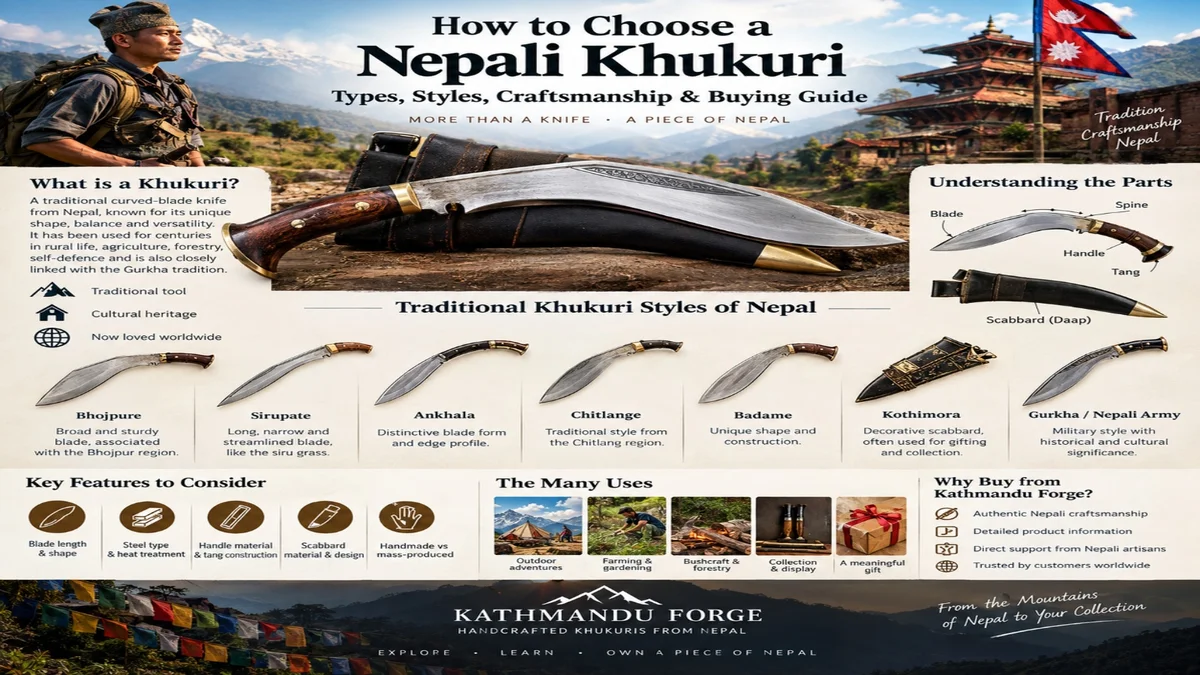
How to Choose a Traditional Nepali Khukuri: A Complete Guide to Styles, Craftsmanship, Uses and Buying
Sep 22, 2026
Read Post